
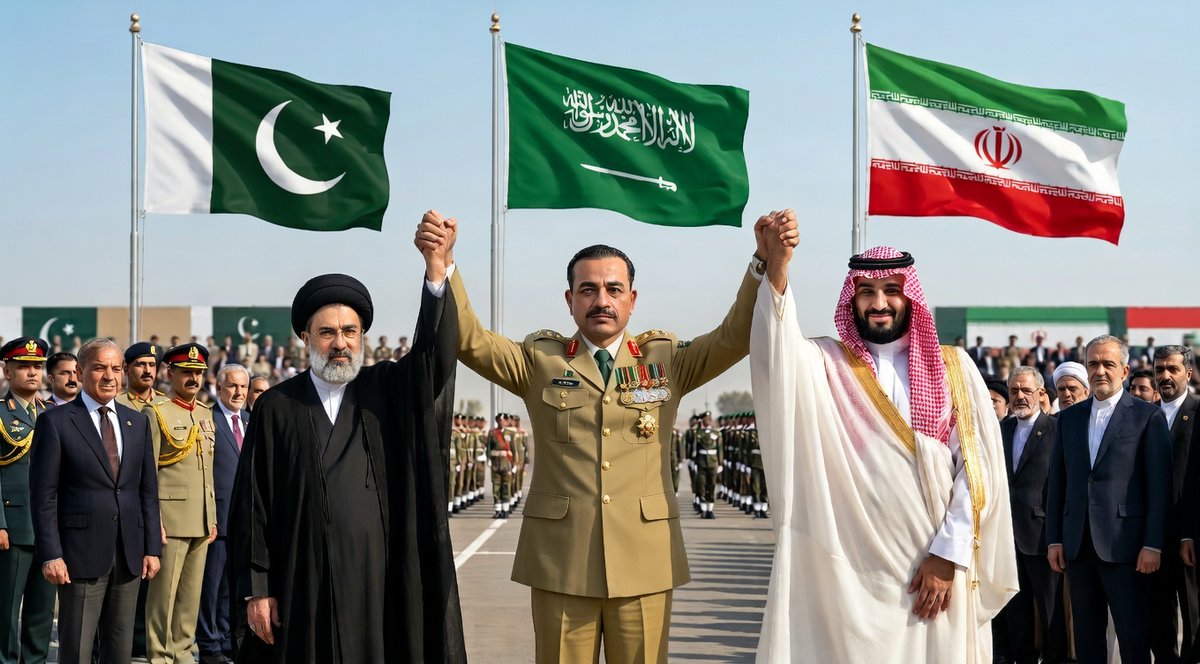
Islamabad, March 14, 2026 – In a region gripped by missile exchanges and fears of wider war, Pakistan is quietly positioning itself as a bridge-builder between arch-rivals Iran and Saudi Arabia. Fresh high-level talks between Pakistan’s Field Marshal Syed Asim Munir and Saudi Defence Minister Prince Khalid bin Salman have sparked analytical projections that Islamabad seeks not just defensive alignment with Riyadh but a broader diplomatic role to de-escalate the Iran–Middle East crisis.
The March 7 meeting in Riyadh, held days after Iranian drones and missiles targeted Saudi territory, officially focused on the “gravity of the security situation” and joint measures under the landmark Saudi-Pakistan Strategic Mutual Defence Agreement signed in September 2025. Saudi statements emphasised halting attacks and urged Tehran to “avoid miscalculation.” Yet Pakistani diplomatic channels tell a parallel story: shuttle diplomacy by Foreign Minister Ishaq Dar between Tehran and Riyadh, coupled with Prime Minister Shehbaz Sharif’s simultaneous engagements with both sides, points to a deliberate strategy of mediation.
Analysts see this as Pakistan leveraging its unique credibility — deep military and economic ties with Saudi Arabia alongside longstanding border and energy links with Iran — to revive the fragile 2023 China-brokered Saudi-Iran détente now strained by the wider conflict.
Plausible Pathways Toward De-escalation
Several realistic trajectories could emerge if Pakistan’s backchannel efforts gain traction:
These pathways are not abstract; Pakistan has historical precedent, having helped mediate aspects of past Iran-Saudi frictions and even contributing to de-escalation efforts in the 1980s Iran-Iraq war through its military diplomacy.
Regional and External Responses, Especially from Israel
Shifting dynamics would inevitably draw reactions. Israel, already engaged in direct strikes on Iranian targets, might view any Saudi-Iran thaw as undermining its “maximum pressure” campaign and could intensify covert operations or public criticism to portray mediation as appeasement. Washington, while publicly backing Gulf allies, may quietly welcome reduced escalation that spares U.S. bases — though any perceived weakening of anti-Iran containment could strain ties. China, the original 2023 broker, would likely endorse Pakistan’s role, seeing it as an extension of its own mediation diplomacy.
Uncertainties, Risks and Conditions for Breakthrough
Importantly, no official confirmation of a decisive mediation outcome has emerged from Islamabad, Riyadh or Tehran. The scenario remains exploratory — a projection of plausible trajectories rather than guaranteed results. Risks are substantial: Iran could interpret Pakistan’s defence pact with Saudi Arabia as bias, hardening its stance; domestic sectarian sensitivities in Pakistan could complicate overt mediation; and external shocks (further Israeli strikes or U.S. escalation) might derail talks overnight.
Success hinges on specific conditions: sustained restraint from all parties, U.S. tacit approval for off-ramps, and Pakistani ability to maintain strategic neutrality despite its defence commitments. Should these align, Islamabad’s quiet diplomacy could transform it from regional player to global mediator — proving that even amid missiles and mistrust, pragmatic middle powers can still shape the path to peace.
For now, the world watches. Pakistan’s dual track — defensive solidarity with Riyadh paired with diplomatic outreach to Tehran — offers a narrow but credible window for de-escalation in one of the most volatile theatres on earth. Whether it widens into a breakthrough or narrows under pressure remains the defining uncertainty of the coming weeks.


No comments yet. Be the first to comment!