
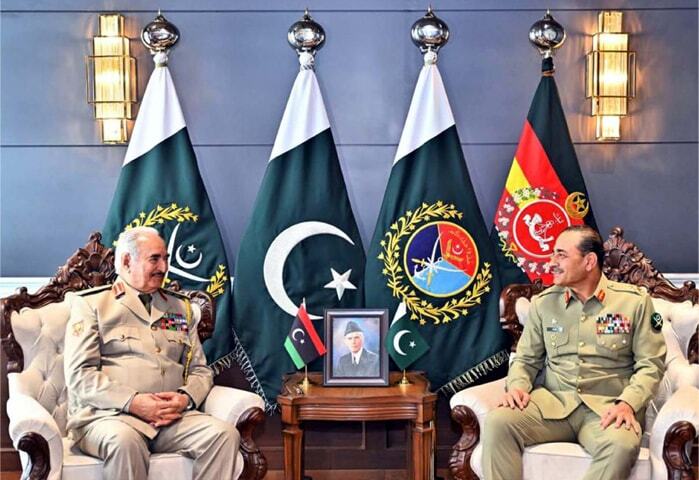
ISLAMABAD: Weeks after signing a more than $4 billion arms deal, Pakistan’s armed forces and Libya’s eastern military on Monday pledged to continue their engagement and collaboration.
“During the meeting, both sides exchanged views on matters of mutual interest, with particular focus on security dynamics in respective regions and professional cooperation,” the Inter-Services Public Relations (ISPR) said in a statement.
The ISPR said Field Marshal Khalifa Abu al-Qasim Haftar, commander in chief of the armed forces of eastern part of Libya, called on Field Marshal Asim Munir, chief of army staff and chief of defence forces, at the General Headquarters. Mr Haftar was accompanied by Osama Saad Hammad, prime minister of Libya’s eastern-based parallel government.
The statement said the discussions underscored the importance of continued engagement and collaboration between the two armed forces, with Field Marshal Munir reaffirming Pakistan’s support for peace, stability and institutional development in Libya.
Field Marshal Munir, Khalifa Haftar discuss regional security dynamics, military cooperation
Mr Haftar’s visit to Pakistan comes roughly six weeks after Islamabad and Libya’s eastern military finalised a major defence agreement during Field Marshal Munir’s visit to Benghazi in December. The deal, signed with Saddam Haftar, Khalifa Haftar’s son and deputy, is valued at over $4bn and is among Pakistan’s largest-ever weapons export agreements.
Under the agreement, Pakistan is to supply 16 JF-17 Thunder multi-role fighter jets, co-developed with China, along with 12 Super Mushshak basic trainer aircraft and other unspecified equipment for air, land and naval forces.
The deal also includes provisions for training, capacity building and potential joint manufacturing, with deliveries expected over the next two and a half years.
Analysts see the reciprocal visit as a signal of follow-through on the December pact for translating the agreement into concrete timelines for deliveries, training and broader military cooperation.
It also projects the relationship between the two sides as a long term strategic partnership rather than a one-off commercial transaction.
If fully implemented, the sale would represent the first export of JF-17 fighter jets to an Arab country, placing Pakistan more firmly within Libya’s eastern military orbit and signalling Islamabad’s intent to expand its defence footprint despite international sensitivities surrounding Libya’s prolonged conflict.
Published in Dawn, February 3rd, 2026

.png)
Your trusted source for breaking news, in-depth analysis, and comprehensive coverage of today's most important stories.
Get daily updates on breaking news, exclusive interviews, and special features delivered to your inbox.
Have a news tip or want to get in touch with our editorial team? We're here to help.
Austin, Texas, USA