
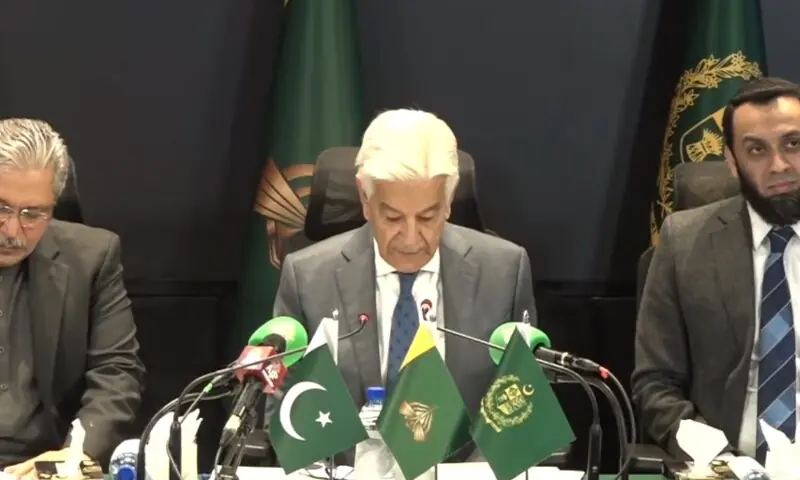
Defence Minister Khawaja Asif on Tuesday said that there was no question of a military operation in Khyber Pakhtunkhwa’s Tirah, insisting that migration was a routine practice in the valley.
Asif made these remarks during a press conference in Islamabad, where he was flanked by Information Minister Attaullah Tarar and Special Assistant to the Prime Minister for Information and Khyber Pakhtunkhwa Affairs Ikhtiar Wali Khan.
The press conference was held two days after the federal and provincial governments traded barbs over who authorised the evacuation process.
The evacuations, which were carried out in line with a plan agreed upon by all stakeholders — including local elders, the provincial government and the military — seem to have become a bone of contention after the displaced populace found themselves stranded in cold weather under open skies, with mismanagement by the authorities only adding to their troubles.
At the outset of the press conference, he said members of the banned Tehreek-i-Taliban Pakistan had been residing in Tirah with their families. “They are around 400-500 in number,” he said.
The defence minister further stated that the provincial government had approved a package of Rs4 billion for the people of Tirah Valley, who were to migrate.
“The armed forces deployed in that area have nothing to do with it. This is an arrangement between the jirga and the provincial government, and as a result of that, this notification was issued,” he added, holding up a notification that he said was issued by the KP government.
On Sunday, a statement by the information ministry also referred to the same notification by the KP Relief, Rehabilitation and Resettlement department for the release of funds, reportedly Rs4 billion, for the anticipated temporary and voluntary movement of the population from certain localities of Tirah (Bagh). These funds were seemingly required for relief-related arrangements for those leaving Tirah.
The statement also asserted that the armed forces or the federal government had not issued any orders for the “depopulation” of Tirah.
It claimed that the federal government and the armed forces did not ask anyone to leave their homes for an operation, adding that intelligence-based operations (IBO) being conducted by the forces in the area did not require “de-population or migration”.
During the press conference, Asif also said that a military operation in the area had been carried out years ago. “And it was strategically decided then that IBOs are way more effective than operations; the collateral damage is way less. So, the armed forces have not carried out an operation since years in favour of the IBOs,” he said.
The minister added, “This is why this practice has been ongoing there for many years, and that is why there is no question of any operation there.”
Moreover, the minister continued, migration in the valley was a routine practice.
He also criticised the KP government’s performance, highlighting a lack of hospitals, schools and police stations in the valley. “Even though, it had been agreed between the provincial government and the jirga that hospitals, police stations and girls’ schools will be established there.”
The minister claimed that there was a “complete absence of civilian law enforcement agencies” in Tirah. “There is no police station there,” he added.
Asif further stated that hemp was being harvested in Tirah over 12,000 acres. Hemp harvested over each acre gave a profit of around Rs3-3.5 million, he said, adding that “this is a major factor” in this matter.
He said that hemp had several uses, including in medicines, construction material and bricks.
“Hemp is harvested there and dividends earned from it either go to the people associated with politics or the TTP. We have initiated measures to stop this, so that [Tirah’s] people benefit from this harvest, and schools and hospitals are constructed there,” Asif added.
He went on to allege that the interests of the provincial government aligned with that of the TTP in Tirah, “as they are together exploiting this source (hemp)”.
The minister recalled that the jirga in Tirah had held meetings on December 11, 21 and 31 last year on the matter.
“It has been meeting the civilian government. You don’t see the military anywhere in this [matter]. And this jirga was constituted many years ago […] And all 24 members of the jirga are onboard. All the things that I have listed that are required there [Tirah], it is their (jirga) demand. Now, in the presence of jirga and this notification, where do you see the military’s [involvement] in this?” Asif said.
He alleged that the KP government wanted to deflect the blame for its “failures” to the military or an operation that did not even exist.
Then, ostensibly referring to the movement of people of in Tirah, he maintained that this “tradition has been in place for decades” due to the climate and topography of the area. It was even mentioned in a gazette from the Bristish era, he added. “This transition takes place every year.”
“This is nothing unusual, but the PTI government has tried to make it [appear] unusual,” he said. Moreover, the KP government had claimed spending Rs2-4bn on setting up camps for the evacuated residents, he said, alleging that those camps did not provide protection from the cold.
He again asserted that the military presence or an operation in Tirah was an “assumption”.
“No operation has been carried out there for years,” he maintained.
He added that if the KP government wanted to work for the betterment of the people of Tirah, the federal government would provide it the wherewithal needed for that purpose.
Speaking after him, Information Tarar said it was stated in the official gazetteer in the 1880s that the Afridi and Akakhel tribes of Khyber descend and migrate to other areas in winters and return to Tirah in summers. “This is an established fact,” he insisted.
For his part, PM’s aide Wali said it needed to be found out that what amount from the Rs4bn package approved by the provincial government had reached the people who had been “forced to relocate”.
“Because the PTI has been in power [in KP] for 13 years, and we know them. They create such programmes and use these funds for campaigns such as street movements,” he alleged.
Wali further highlighted that the KP government’s notification that the movement of people from Tirah would be “voluntary”.
“This proves my points that a project was created to mint money,” he argued, adding that the armed forces had nothing to do with the movement of people in Tirah, “you call it depopulation or forced relocation”.
The PM’s said that to his understanding, that the people of Tirah would be used to ensure the success of the opposition’s protest on February 8.
Following that, a journalist sought confirmation of the number of people who had left Tirah, saying that international media reported that 65 per cent had vacated their houses.
To that, Asif said “people escape the snow in the area and relocate. And it more or less 65pc people migrate […] There is historical evidence of this. And this will continue to happen in the future as well”.
He said that this matter had been “politicised”, asserting that an impression had been created as if “forced relocation” had been taking place in Tirah.
“And it is being linked to us. Even if forced [relocation] is taking place, it is between the provincial government that population. We or the military has nothing to do with it.
“The military has been carrying out IBOs there and will continue to do so. As I said, there are around 500 TTP members there […] The military conducts IBOs and weed them out,” he said.
When asked about KP Chief Minister Sohail Afridi’s claim that he had not been involved in talks with tribal elders from Tirah, Asif said: “This is his and his government’s problem. The talks were held with his government, and if he was not in the loop, that is not my problem or the problem of the federal government.”
He also alleged that some TTP militants had been paying extortion money to some individuals in the KP government.
In reply to another question, he clarified that no operation was being carried out in Tirah.
The minister was also whether the option of reversing the decision to merge erstwhile tribal areas with KP was being considered in a potential “next amendment”. Asif said no such proposal was being considered.
When asked who formed the jirga that held talks regarding the evacuation of people from Tirah, Asif insisted that it was the provincial government.
A journalist also pointed out to the government representatives that migration from Tirah had been taking place in late October or early November. “What migration is this that a man, along with his five and children, goes towards death?” he questioned.
At that, Information Minister Tarar reasoned that it was so because of the shift in weather patterns due to climate change. “Previously, there was no snowfall in January end. It used to start in November,” he said.

No comments yet. Be the first to comment!
.png)
Your trusted source for breaking news, in-depth analysis, and comprehensive coverage of today's most important stories.
Get daily updates on breaking news, exclusive interviews, and special features delivered to your inbox.