
• Reserved rulings should be announced within 90 days, bench holds
• Judgement harks back to ‘premature uploading’ of two IHC judges’ verdict in Tyrian White case
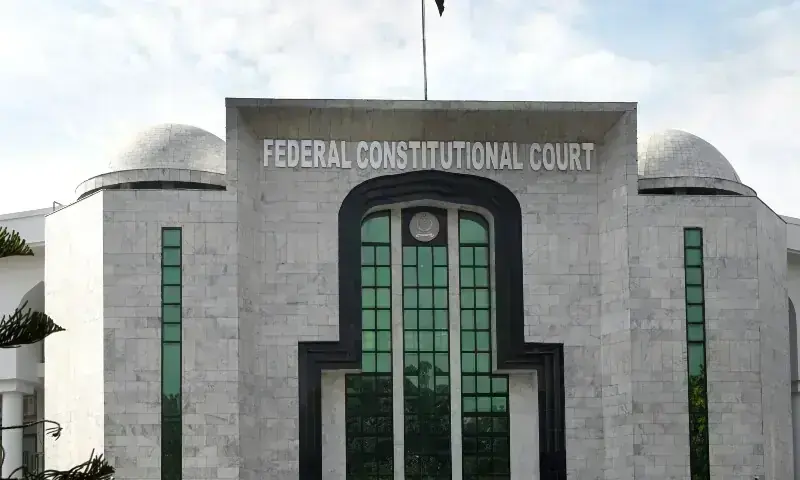
ISLAMABAD: At least two judges of the Islamabad High Court (IHC) are likely to come under scrutiny after the Federal Constitutional Court (FCC) termed the circulation of incomplete or unannounced judgements a grave judicial misconduct and an offence, warning that such actions could undermine the integrity of the judicial process.
However, at the same time, the constitutional court also censured inordinate delays in announcing reserved judgements.
In the specific case reviewed by the bench, the Sindh High Court had taken 10 months to deliver a judgement that the FCC noted “cast a reflection on the bench” for failing to administer justice expeditiously.
In a detailed judgement, authored by FCC Justice Aamer Farooq and concurred with by Justice Rozi Khan Barrech, the bench observed that once a judgement is reserved, it remains within the exclusive domain of the bench until it is officially announced, and any premature disclosure may violate established judicial norms.
It may be recalled that in 2024, Justice Farooq, who was IHC chief justice at the time, had dissolved a three-member bench hearing the Tyrian White case before reconstituting it for rehearing.
However, before any formal pronouncement of the judgement or issuance of a cause list, the opinions of two judges were uploaded on the court’s official website.
The registrar’s office later clarified that the upload of the 31-page opinion by Justice Mohsin Akhtar Kayani and Justice Arbab Mohammad Tahir was against the rules, as it was done without the announcement of the judgement, without prior notice to the parties, and without the signature of the chief justice who was the third member of the bench.
According to the registrar, the uploaded document did not constitute a judgement of the court. The office also announced that action would be taken against those responsible for uploading the opinion and confirmed that the chief justice had reconstituted the bench for rehearing of the case.
‘Breach of discipline’
In its ruling, the FCC stressed that the release or circulation of a judgement prior to its announcement not only breaches procedural discipline but may also render the pronouncement legally questionable. It noted that such conduct could create uncertainty regarding the authenticity of the decision and erode public confidence in the judiciary.
The constitutional court termed the circulation of an incomplete judgement “an offence”, holding that, “If any person or party comments upon, discloses, or circulates the contents of a reserved judgement prior to its formal pronouncement and issuance as an order of the court, such conduct may constitute an offence.”
The judgement warned that if the contents of a reserved decision are disclosed or circulated before its formal announcement, the matter may even require rehearing to preserve the sanctity of the judicial process.
It further highlighted that superior courts operate under strict conventions that require judgements to be announced in open court after due notice to litigants. According to the ruling, the circulation of draft or incomplete opinions outside this framework amounts to serious misconduct and could expose those responsible to legal consequences.
The bench clarified that a judgement only becomes a “perfect and complete” order of the court once it is signed by the judges.
“Unless it is duly signed by the judges and formally pronounced or made public, it remains merely a draft,” the court noted, adding that premature disclosure constitutes a breach of the confidentiality that serves as a hallmark of judicial independence.
The FCC also addressed the issue of reserved judgements lingering for too long. The court noted: “High courts should ideally pronounce a reserved judgment within 90 days.”
If a judgement is delayed beyond this time frame, it is “frowned upon” and can serve as a valid ground for setting the judgement aside.
The FCC directed that this judgement be circulated to all high courts for “strict compliance and observance” to ensure the dispensation of justice remains certain and transparent.
Published in Dawn, March 17th, 2026

No comments yet. Be the first to comment!