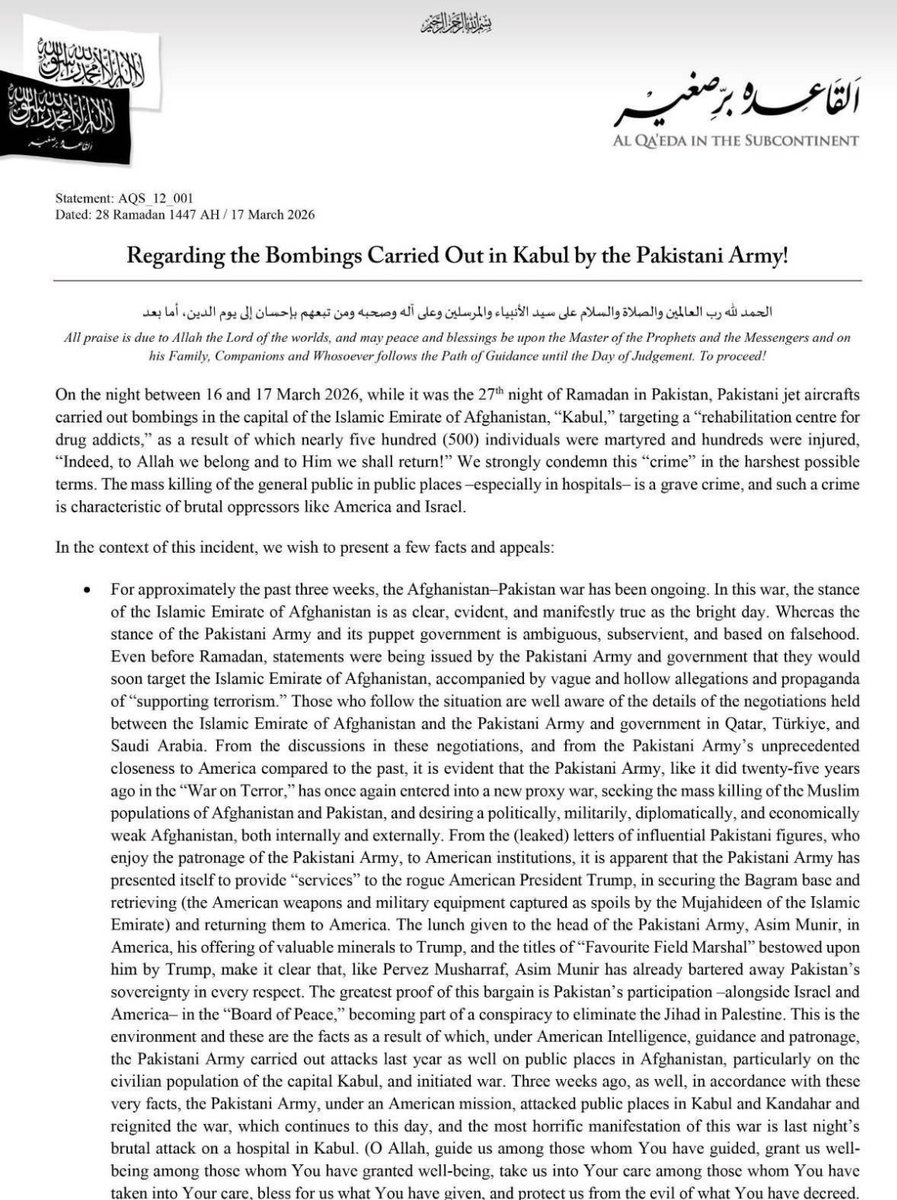
"Al-Qaeda on the Defensive: Messaging, Misdirection, and Mounting Losses On March 17, 2026, Al-Qaeda in the Indian Subcontinent (AQIS) released a formal statement in Kabul responding to Pakistani Military airstrikes conducted between March 16 and 17. The statement is significant not just for what it says, but for what it attempts to conceal. AQIS framed the strikes as an attack on civilians, claiming Pakistani warplanes targeted a “drug rehabilitation center” and caused mass casualties. This claim is misleading and part of a deliberate information strategy. The actual target was a Taliban weapons depot containing AQIS weapons, located in close proximity to the facility referenced in their statement. By centering its narrative on the civilian site, AQIS is attempting to redirect attention away from the loss of its own operational assets. The group’s messaging follows a familiar al-Qaeda playbook. It blends religious framing, claims of civilian harm, and accusations against those fighting them, portraying in this case the Pakistani military as acting on behalf of the United States and Israel. The irony is that there are members of Hamas inside a dozen al-Qaeda camps in Afghanistan. This is likely not something they want to highlight, particularly to Israel, as Afghanistan is where Hamas is working to reestablish its presence. The AQIS statement, which I have attached here, repeatedly invokes martyrdom, frames the conflict as a “proxy war,” and positions AQIS as a defender of the Afghan Taliban and the broader Muslim population, even as al-Qaeda and the Taliban are among the groups causing the most harm and deaths to Muslims in the Pakistan–Afghanistan border region. This is not just rhetoric. It is a calculated effort to mobilize support, shape perception, and obscure battlefield realities. The statement also signals alignment with the Taliban, reinforcing a unified front against Pakistan and, frankly, the rest of us, while laying the groundwork for continued escalation. By invoking external actors and alleged ties to Western influence, al-Qaeda, using its AQIS affiliate, is attempting to broaden the conflict narrative beyond the immediate strikes. They are testing the waters to see how AQIS messaging resonates, then will amplify their media efforts accordingly. But the operational reality tells a different story. These strikes are not isolated, and they are not limited to just the Taliban or the Haqqani Network. Pakistani military operations are now impacting multiple layers of al-Qaeda’s presence, including its Afghanistan-based networks, its core senior leadership infrastructure, and key affiliates such as Tehrik-e-Taliban Pakistan (TTP) and the Islamic Movement of Uzbekistan (IMU). One of al-Qaeda’s primary external operations training sites has been targeted, a site that was central to its U.S. homeland plotting, along with several weapons depots tied to the group's broader operational planning. This reflects disruption at a structural level, not just a tactical one. There are also clear indicators that al-Qaeda is absorbing significant losses. Foreign fighters are being moved into hospitals using Afghan identification to mask their identities and obscure casualty figures. At the same time, the group has accelerated burial practices, conducting rapid interments of foreign operatives to limit visibility into the scale of fatalities. These are not the actions of an organization operating freely. They are the behaviors of a network under pressure and actively attempting to conceal the extent of that pressure. For years, al-Qaeda operated in Afghanistan with near-total freedom of movement, training, and coordination. That environment allowed the group to rebuild capabilities, strengthen external operations planning, and deepen ties with regional affiliates. What is happening now represents a meaningful shift. This week has been the most significant blow to al-Qaeda’s presence in Afghanistan since the strike that killed Dr. Ayman al-Zawahiri in July 2022. Unlike that operation, which removed a single leader, these strikes are targeting infrastructure, logistics, and weapons sites simultaneously. Viewed in this context, AQIS’s statement reads less like a position of strength and more like a reactive narrative. It is an attempt to control perception at a moment when operational realities are moving in the opposite direction. Al-Qaeda is not simply issuing a statement. It is adapting under pressure, absorbing losses, and attempting to hide the full extent of the damage. Let's not let them!"